
Intestate Succession in South African Customary Law: When Tradition Meets the Constitution
Introduction
In South Africa, many people die without leaving a valid will, leaving their families to navigate the law of intestate succession. Now imagine a father dies without a valid will, survived by his wife, two daughters and a son. Who inherits? Does the eldest son inherit? What happens to the wife and daughters? And what if the deceased had more than one wife and children from different households?
These questions bring into focus the intersection between African customary law, succession and constitutional rights in South Africa. When a person dies without a valid will, the question is simple: who inherits, and under which rules does inheritance then take place?
Historical Context of Succession
The position was different under the former statutory framework. Section 23 of the Black Administration Act 38 of 1927 regulated the succession of property belonging to Black persons and provided that certain property, including particular movable property connected to a customary union or family “house” and certain land held under quitrent tenure, would devolve according to Black law and custom. Other property could be disposed of by will. Section 1(4)(b) of the Intestate Succession Act 81 of 1987 excluded estates falling within section 23 from the Act, while regulations made under section 23 provided for the administration and distribution of such estates. Consequently, where a Black person died intestate, property falling within section 23 devolved according to customary-law rules, including male primogeniture, which played a central role in determining who could inherit.
The Evolution of Intestate Succession: From Customary Law to Constitutional Reform
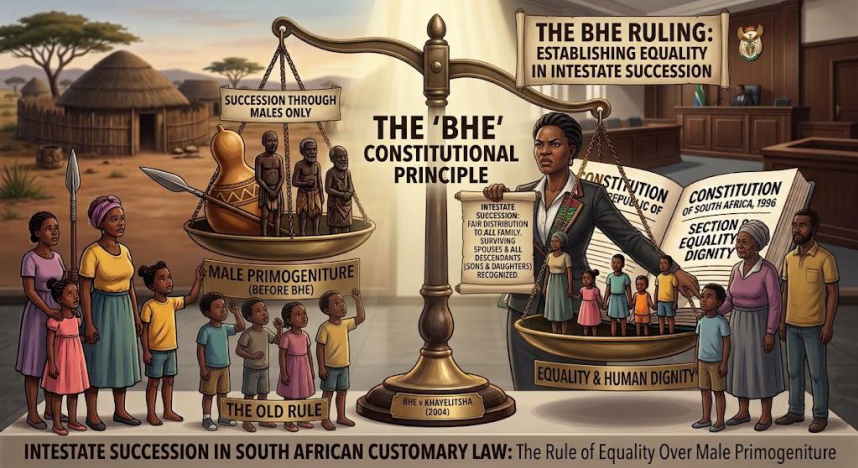
In 2004, the Constitutional Court’s decision in Bhe and Others v Khayelitsha Magistrate and 2005 (1) SA 580 (CC) marked a significant turning point. The case arose after Vuyisile Mgolombane died intestate, leaving behind his partner, Nontupheko Bhe, and their two minor daughters. Under the customary-law succession rules then applicable, the daughters could not inherit because they were female. Instead, the deceased’s father was appointed as the representative and sole heir of the estate. When he sought to sell the property where Bhe and her children lived, the dispute reached the courts.
The case placed the rule of male primogeniture and the statutory system that gave effect to it directly before the Constitutional Court. The Court found that the exclusion of women and extra-marital children from inheritance was inconsistent with the constitutional rights to equality and human dignity and declared the customary-law rule of male primogeniture, insofar as it excluded or hindered women and extra-marital children from inheriting property, inconsistent with the Constitution and invalid.
It further declared section 23 of the Black Administration Act, the regulations made under it and section 1(4)(b) of the Intestate Succession Act unconstitutional and invalid. From 15 October 2004, the Intestate Succession Act was ordered to apply to intestate estates irrespective of the deceased’s cultural affiliation, fundamentally changing the legal position of customary intestate succession. Importantly, the Court did not reject African customary law as a whole.
The Present-Day Position: Intestate Succession Under Customary Law
Following Bhe, the Reform of Customary Law of Succession and Regulation of Related Matters Act 11 of 2009 was enacted to give effect to the constitutional principles governing customary succession. Where a person subject to customary law dies without a valid will, the estate generally devolves in accordance with the Intestate Succession Act, subject to the Reform Act. The former rule of male primogeniture no longer determines succession merely because the deceased was subject to customary law.
The present framework therefore recognises surviving spouses and descendants as beneficiaries of an intestate estate, including in circumstances involving polygamous customary marriages. This represents a significant departure from the former system, under which succession could depend on the gender of the potential heir and the structure of the family.
This does not mean that customary law has disappeared from succession. African customary law remains recognised by section 211 of the Constitution, and customary practices continue to form an important part of family life in South Africa. However, customary law must operate consistently with the Constitution and legislation.
Why does having a valid Will matter?
Intestate succession provides the legal rules for distributing an estate where there is no valid will, but those rules may not reflect the deceased’s wishes, particularly where there are multiple spouses, children from different relationships, or complex family arrangements.
A valid will allows a person to state their wishes, provide for their intended beneficiaries, and reduce uncertainty or disputes in the administration of the estate. Intestate succession provides the default; a valid will allows the deceased to make the choice.
Conclusion
The development of customary intestate succession in South Africa reflects the changing relationship between tradition, family responsibility and constitutional equality. The traditional system of male primogeniture placed succession within the broader role and responsibilities of the family head. Bhe, however, fundamentally changed the legal position by declaring its discriminatory application unconstitutional, with subsequent legislation further reshaping the framework governing customary intestate estates.
So, who inherits when there is no valid will? Today, the answer is determined principally by legislation within a constitutional framework, rather than by male primogeniture alone. Customary law remains recognised and relevant, but its application must operate within the boundaries of the Constitution. Ultimately, understanding these developments is important not only for knowing who may inherit, but also for understanding why making a valid will remains one of the clearest ways to provide certainty for those left behind.
Candidate Attorney