
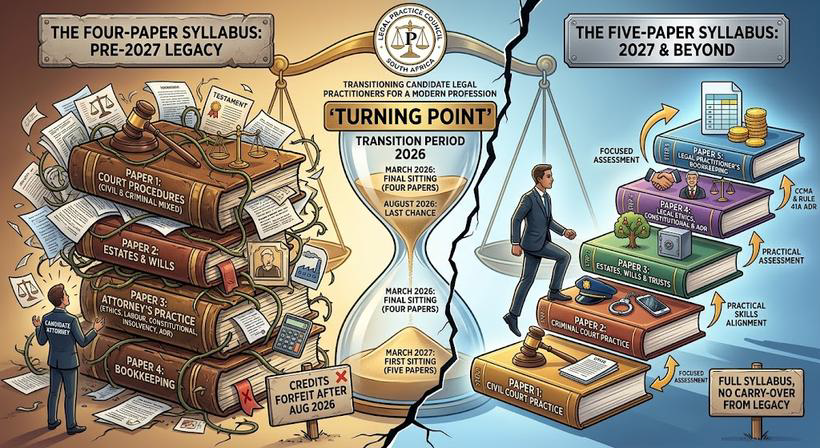
The candidate attorneys’ examination system in South Africa is undergoing a significant change as the Legal Practice Council (LPC) moves from the existing four-paper examination structure to a new five-paper Competency-Based Assessment (CBA) syllabus.
Candidate legal practitioners face significant challenges in passing the competency-based admission examinations, as reflected in high failure rates, professional concerns, and the Legal Services Ombud’s investigation.
A major difficulty is the breadth of subject matter covered in individual papers, with several distinct areas of law being examined together at once. Candidates have reported to have been facing not only a heavy volume of material but also a significant cognitive and time-management burden. Moreover, candidates report that papers are excessively long and difficult to complete within the allocated exams hours.
Most candidates have opted to split the four exams into two separate sittings, by writing Paper 1 and 2 in the first sitting and then writing Paper 3 and 4 in the next sitting. However, the same students still believed that is has been not only a time burden but also has financial implications, given that most candidates are facing financial challenges.

It has been reported that the new syllabus is intended to place greater emphasis on practical competence rather than simply testing theoretical knowledge. It reorganises the required learning into a five-paper assessment framework and is linked to the structured Practical Vocational Training programme prescribed under Regulation 6(10) of the Legal Practice Act. The LPC has also developed standardised study guides to assist candidates in preparing for the new assessments.
The first assessments under the new five-paper system are scheduled for March 2028, making 2027 a critical transitional year. The LPC has indicated that the new framework is intended to improve the practical relevance, consistency and integrity of the qualification process.
For candidate attorneys, however, the transition brings both opportunity and uncertainty. Those still completing the old syllabus face pressure to use the final available sitting, while future candidates must prepare for a substantially reorganised examination system. The change therefore represents more than a new set of examination papers; it marks a shift in how aspiring attorneys are expected to demonstrate their readiness to practise.
The New five paper syllabus has been structured as follows:
The restructuring of the examination syllabus represents a significant change from the previous four-paper system. While the new structure seeks to create a more focused and logical allocation of subject matter, it also introduces additional competencies and technological expectations that candidates must acquire and demonstrate.
The obstacle is what I like to call ‘the bigger picture’. During my attendance at law school in 2025, we were informed that the manner in which legal accounting and transactions are recorded could also be subject to significant changes. Under the previous approach, candidates were accustomed to manual methods of recording transactions, including the preparation of tables, manual entries and other traditional bookkeeping exercises. It was indicated that the LPC will move towards a more technology-driven method of recording and managing legal accounting transactions through computer software.
This development is significant because it introduces an additional practical competency that candidates are expected to acquire alongside their substantive legal knowledge. Candidates are therefore no longer required merely to understand the underlying principles of legal accounting, trust accounting and the recording of transactions. They may also be required to understand how those transactions are captured, processed and managed using computer-based systems.
The introduction of technology into the assessment framework creates an additional preparation requirement for candidate attorneys. Candidates who have previously been exposed primarily to manual methods of recording transactions may require additional training, practical exposure and familiarisation with the relevant software before they can competently perform the required tasks. A candidate may therefore understand the legal and accounting principles being tested but still experience difficulty in an examination if he or she is unfamiliar with the technological platform through which those principles are required to be applied.
This is particularly important because examination performance should ideally measure the candidate’s legal competence rather than unfamiliarity with an assessment technology or software platform. Where a new computerised system is introduced, sufficient information, training, guidance and opportunity for practice should consequently be provided to candidates before the system is assessed.
Furthermore, the transition to the new syllabus means that candidates are required to adapt to two forms of change simultaneously: first, the redistribution of substantive legal subjects across five papers; and second, the introduction or increased emphasis on technological competencies within legal practice. The latter reflects the changing nature of the legal profession, where attorneys increasingly utilise electronic accounting systems, practice-management software, digital filing systems and other technological tools in the ordinary course of practice.
While the inclusion of ICT and computerised legal accounting is therefore understandable and arguably necessary to ensure that newly admitted legal practitioners are equipped for modern legal practice, the transition must nevertheless be managed carefully. Candidates should not be disadvantaged merely because the technological component is new or because they have not previously had meaningful exposure to the particular software or recording system that will be prescribed by the LPC.
Accordingly, the implementation of the new five-paper syllabus should be accompanied by clear guidance, prescribed training materials, practical demonstrations, sample transactions, access to the relevant software or simulations, and sufficient opportunity for candidates to practise before the competencies are formally assessed. This would promote consistency and ensure that candidates are assessed on their ability to apply the relevant legal and accounting principles rather than on their ability to independently learn an unfamiliar technological system.
Candidate Attorney
The candidate attorneys’ examination system in South Africa is undergoing a significant change as the Legal Practice Council (LPC) moves from the existing four-paper examination structure to a new five-paper Competency-Based Assessment (CBA) syllabus.
Candidate legal practitioners face significant challenges in passing the competency-based admission examinations, as reflected in high failure rates, professional concerns, and the Legal Services Ombud’s investigation.
A major difficulty is the breadth of subject matter covered in individual papers, with several distinct areas of law being examined together at once. Candidates have reported to have been facing not only a heavy volume of material but also a significant cognitive and time-management burden. Moreover, candidates report that papers are excessively long and difficult to complete within the allocated exams hours.
Most candidates have opted to split the four exams into two separate sittings, by writing Paper 1 and 2 in the first sitting and then writing Paper 3 and 4 in the next sitting. However, the same students still believed that is has been not only a time burden but also has financial implications, given that most candidates are facing financial challenges.
It has been reported that the new syllabus is intended to place greater emphasis on practical competence rather than simply testing theoretical knowledge. It reorganises the required learning into a five-paper assessment framework and is linked to the structured Practical Vocational Training programme prescribed under Regulation 6(10) of the Legal Practice Act. The LPC has also developed standardised study guides to assist candidates in preparing for the new assessments.
The first assessments under the new five-paper system are scheduled for March 2028, making 2027 a critical transitional year. The LPC has indicated that the new framework is intended to improve the practical relevance, consistency and integrity of the qualification process.
For candidate attorneys, however, the transition brings both opportunity and uncertainty. Those still completing the old syllabus face pressure to use the final available sitting, while future candidates must prepare for a substantially reorganised examination system. The change therefore represents more than a new set of examination papers; it marks a shift in how aspiring attorneys are expected to demonstrate their readiness to practise
The New five paper syllabus has been structured as follows:
The restructuring of the examination syllabus represents a significant change from the previous four-paper system. While the new structure seeks to create a more focused and logical allocation of subject matter, it also introduces additional competencies and technological expectations that candidates must acquire and demonstrate.
The obstacle is what I like to call ‘the bigger picture’. During my attendance at law school in 2025, we were informed that the manner in which legal accounting and transactions are recorded could also be subject to significant changes. Under the previous approach, candidates were accustomed to manual methods of recording transactions, including the preparation of tables, manual entries and other traditional bookkeeping exercises. It was indicated that the LPC will move towards a more technology-driven method of recording and managing legal accounting transactions through computer software.
This development is significant because it introduces an additional practical competency that candidates are expected to acquire alongside their substantive legal knowledge. Candidates are therefore no longer required merely to understand the underlying principles of legal accounting, trust accounting and the recording of transactions. They may also be required to understand how those transactions are captured, processed and managed using computer-based systems.
The introduction of technology into the assessment framework creates an additional preparation requirement for candidate attorneys. Candidates who have previously been exposed primarily to manual methods of recording transactions may require additional training, practical exposure and familiarisation with the relevant software before they can competently perform the required tasks. A candidate may therefore understand the legal and accounting principles being tested but still experience difficulty in an examination if he or she is unfamiliar with the technological platform through which those principles are required to be applied.
This is particularly important because examination performance should ideally measure the candidate’s legal competence rather than unfamiliarity with an assessment technology or software platform. Where a new computerised system is introduced, sufficient information, training, guidance and opportunity for practice should consequently be provided to candidates before the system is assessed.
Furthermore, the transition to the new syllabus means that candidates are required to adapt to two forms of change simultaneously: first, the redistribution of substantive legal subjects across five papers; and second, the introduction or increased emphasis on technological competencies within legal practice. The latter reflects the changing nature of the legal profession, where attorneys increasingly utilise electronic accounting systems, practice-management software, digital filing systems and other technological tools in the ordinary course of practice.
While the inclusion of ICT and computerised legal accounting is therefore understandable and arguably necessary to ensure that newly admitted legal practitioners are equipped for modern legal practice, the transition must nevertheless be managed carefully. Candidates should not be disadvantaged merely because the technological component is new or because they have not previously had meaningful exposure to the particular software or recording system that will be prescribed by the LPC.
Accordingly, the implementation of the new five-paper syllabus should be accompanied by clear guidance, prescribed training materials, practical demonstrations, sample transactions, access to the relevant software or simulations, and sufficient opportunity for candidates to practise before the competencies are formally assessed. This would promote consistency and ensure that candidates are assessed on their ability to apply the relevant legal and accounting principles rather than on their ability to independently learn an unfamiliar technological system.
Candidate Attorney