
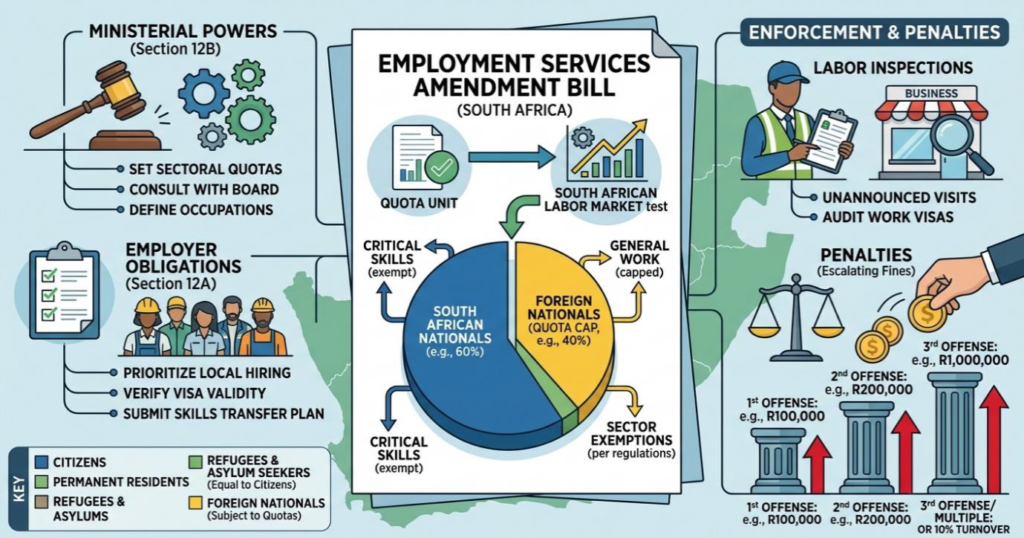
South Africa’s approach to the employment of foreign nationals may be entering a new phase. The Employment Services Amendment Bill, 2026 (“the Bill”) proposes substantial amendments to the Employment Services Act 4 of 2014 (“the Act”), introducing a dedicated framework for the employment of foreign nationals, providing for possible quotas, imposing additional obligations on employers and strengthening enforcement mechanisms. The Bill is intended to regulate the employment of foreign nationals in a manner that is consistent with the Constitution of the Republic of South Africa, 1996, the Immigration Act 13 of 2002 and the Refugees Act 130 of 1998, while promoting employment opportunities and the development of South African skills. Importantly, the Bill does not itself establish a fixed percentage of foreign nationals that employers may employ. Instead, it creates a framework through which such limits may subsequently be introduced.
The Bill first revises the terminology of the Act by introducing and amending key definitions, including “employer”, “employment”, “worker”, “asylum seeker”, “refugee”, “permanent resident”, “critical skills” and “illegal foreigner”. Notably, it broadens the definition of “worker” to include any person who performs work for another in exchange for payment, whether in money or in kind, thereby extending the Act beyond the traditional employment relationship. It also amends the definition of “foreign national” to exclude permanent residents, refugees and asylum seekers, with the stated intention of affording persons applying for or granted refugee status the same employment status as
citizens and permanent residents. These revised definitions form the foundation for the Bill’s proposed regulatory framework.
The Bill proposes the insertion of Chapter 3A, which prohibits the employment of a foreign national unless the person is legally authorised to work under the Immigration Act, Refugees Act, other applicable law or an international agreement binding on South Africa. The Bill places a heightened compliance burden on employers, requiring them to satisfy specific requirements before employing a foreign national. They will have to:
This shifts greater responsibility onto employers, making foreign-worker compliance an employment-law obligation, rather than an issue limited to immigration status.
The Bill creates a mechanism through which the Minister of Employment and Labour, after consulting the Employment Services Board, may establish maximum quotas for foreign nationals. A quota may apply to a particular sector, occupation, region or the country as a whole, and may cover employees/ workers. The quota system is not automatic, and the Bill does not specify the actual number or percentage of foreign nationals that may be employed. Before a quota is introduced, a draft notice must be published in the Government Gazette, and interested parties must be given at least 30 days to comment. When determining a quota, the Minister must consider matters including the availability of requisite and critical skills among South Africans, refugees and asylum seekers, applicable sectoral determinations and bargaining councils, and South Africa’s international obligations. Small employers would generally be excluded from the quota provisions, with a small employer being a non-public-sector employer employing fewer than 10 employees, subject to the Bill’s conditions. In determining applicable quotas, the Minister must consider relevant factors, including the purpose of the Act, applicable sectoral determinations and bargaining councils, the availability of requisite and critical skills among South Africans, refugees and asylum seekers, and
South Africa’s international obligations concerning the employment of foreign nationals. Employers may not exceed an applicable quota unless they have been granted an exemption under the Act.
Protections for foreign workers complement the aforementioned obligations. While the Bill places greater responsibility on employers to ensure that foreign nationals are lawfully employed and that applicable requirements are met, it does not permit employers to avoid their obligations towards workers on the basis that the employment was unlawful. Under the proposed section 12D, a worker employed in contravention of the new framework would nevertheless remain entitled to enforce claims arising under applicable legislation, collective agreements or contracts against the employer or any other person who may be liable. This is particularly significant in preventing employers from exploiting foreign workers and subsequently relying on the unlawful nature of the employment to evade their contractual or statutory obligations, including obligations relating to remuneration and other employment rights. The Bill further reinforces employer responsibility by prohibiting an employer from requiring or permitting a foreign national to perform work that falls outside the scope of the work authorised by the relevant visa or permit. Compliance would therefore extend beyond verifying a foreign national’s right to work in South Africa; employers would also be required to ensure that the work actually performed corresponds with the authorisation granted.
It would be easy to view the proposed amendments solely through the lens of undocumented immigration. That would, however, overlook an important distinction in the Bill. However, the proposed framework applies to the employment of foreign nationals generally, while specifically prohibiting the employment of persons who are not legally authorised to work. In the same breath, the Bill recognises that South Africa requires foreign skills where those skills are genuinely needed. Its stated objectives include facilitating the employment of foreign nationals where their contribution is required, promoting critical skills and ensuring that foreign employment does not adversely affect existing labour standards or the rights and expectations of South African workers. The proposed system is therefore not an outright prohibition on foreign employment. Rather, it seeks to make foreign employment regulated, justified and accountable.
The Bill significantly strengthens the enforcement framework. Labour inspectors would be expressly empowered to monitor and enforce compliance with the Act, while
proposed section 49(2A) introduces substantially higher penalties for contraventions of the foreign-employment provisions. These range from R100,000 for a first contravention to the greater of R1 million or 10% of an employer’s turnover for employers with two or more previous contraventions. In determining the appropriate penalty, the Labour Court must also consider any economic benefit derived from the contravention.
If enacted, employers employing foreign nationals would need to adopt a more structured compliance process. They would need to consider:
The Bill therefore moves responsibility for foreign-worker compliance firmly into the employment-law sphere.

The debate surrounding the Employment Services Amendment Bill, 2026 cannot be understood solely through legislation, regulations and compliance obligations. It must also be understood against the lived realities of South Africans confronting unemployment, pressure on public services and concerns about the enforcement of immigration laws.
The emergence of movements such as March C March demonstrates that immigration is no longer an issue confined to government departments or legal policy. It has become a matter of public concern. The movement’s emphasis on stronger immigration enforcement, citizen access to employment and services, and accountability reflects frustrations that exist within communities across South Africa.

In this respect, the Bill speaks directly to a concern that many South Africans are already expressing: the employment of foreign nationals should not occur without proper consideration of the South African labour market.
The proposed legislation would require employers to consider whether suitably skilled persons are available in South Africa before recruiting foreign nationals. It would also permit the Minister, following consultation with the Employment Services Board and a public comment process, to establish maximum quotas for foreign nationals in specified sectors, occupational categories or regions. Yet a democratic society must resist the temptation to reduce this debate to a choice between South Africans and foreign nationals.
South Africans are entitled to ask whether government is doing enough to protect access to employment. Employers are entitled to ask whether regulation will allow them to obtain skills that South Africa genuinely lacks. Foreign nationals who are lawfully entitled to work are entitled to expect that they will not be exploited or treated as disposable labour. And government is required to reconcile these interests within the Constitution and the rule of law.
The legitimate concern, therefore, is not that every foreign national working in South Africa represents a threat to South Africans. Nor is it reasonable to dismiss citizens’ concerns about unemployment and immigration as xenophobic simply because those
concerns involve foreign nationals.The democratic question is whether South Africa can build an immigration and labour system that is both firm and fair.
March C March’s citizen-first advocacy brings the public dimension of that question into sharp focus. The Bill represents the state’s attempt to translate some of those concerns into a regulatory framework. But legislation alone cannot resolve the underlying problems. Effective border management, accurate immigration records, meaningful enforcement, investment in local skills, fair recruitment practices and opportunities for South African work seekers must operate alongside the new legal framework.
Ultimately, the success of the Bill should not be measured merely by how many foreign workers are excluded from the labour market. It should be measured by whether South Africans have greater access to meaningful employment while South Africa remains capable of attracting and retaining the skills it genuinely needs. That is the balance a constitutional democracy should demand.
The Employment Services Amendment Bill, 2026 signals a significant shift in South Africa’s approach to the employment of foreign nationals, placing greater responsibility on employers to justify and demonstrate compliance with foreign-worker requirements. The concerns raised by March C March illustrate the real-world pressures underlying this shift, particularly the call for stronger enforcement and greater protection of employment opportunities for South Africans. While these concerns find resonance in the Bill, its implementation must remain consistent with the Constitution, protecting the rights of lawfully employed foreign nationals and recognising skills that South Africa genuinely requires. Ultimately, the challenge is to achieve a labour market that is firm in protecting South African opportunities, fair in its treatment of foreign nationals, and firmly grounded in the Constitution and rule of law.
Candidate Attorney