
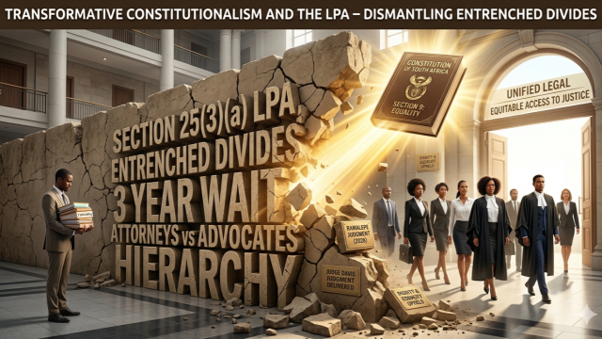
There has long been debate on whether it is fair for attorneys to be subjected to the requirement of actively practising for three years before being eligible to apply for High Court right of appearance, whereas advocates are eligible to appear in all courts immediately upon admission. This dual-track system has perpetuated a divided profession. In the recent groundbreaking judgment of Ramalepe and Others v Minister of Justice and Constitutional Development and Others (121865/2025) [2026] ZAGPPHC 443, two bathe High Court declared section 25(3)(a) of the Legal Practice Act 28 of 2014 unconstitutional and invalid. This article dissects the judgment delivered by Judge Davis and concludes with my personal reflections on this development.
Before engaging with the High Court judgment central to this article, it is essential to outline the constitutional and statutory framework which the Court had to grapple with.Section 9 of the Constitution of the Republic of South Africa, 1996 (“Constitution”)-Equality provides that:
Section 10 of the Constitution -Human Dignity provides that: Everyone has inherent dignity and the right to have their dignity respected and protected.
Section 22 of the Constitution – Freedom of trade, occupation and profession provides that: Every citizen has the right to choose their trade, occupation or profession freely. The practice of a trade, occupation or profession may be regulated by law.
Section 25 of the Legal Practice Act 28 of 2014 (“LPA”) provides that:
(1) Any person who has been admitted and enrolled to practise as a legal practitioner in terms of this Act, is entitled to practise throughout the Republic, unless his or her name has been ordered to be struck off the Roll or he or she is subject to an order suspending him or her from practising.
(2) A legal practitioner, whether practising as an advocate or an attorney, has the right to appear on behalf of any person in any court in the Republic or before any board, tribunal or similar institution, subject to subsections
(3) and (4) or any other law.
(3) An attorney who wishes to appear in the High Court, the Supreme Court of Appeal or the Constitutional Court must apply to the registrar of the Division of the High Court in which he or she was admitted and enrolled as an attorney for a prescribed certificate to the effect that the applicant has the right to appear in the High Court, the Supreme Court of Appeal or the Constitutional Court and which the registrar must issue if he or she is satisfied that the attorney— (a) (i) has been practising as an attorney for a continuous period of not less than three years: Provided that this period may be reduced in accordance with rules made by the Council if the attorney has undergone a trial advocacy training programme approved by the Council as set out in the rules; (ii) is in possession of an LLB degree; and (iii) has not had his or her name struck off the Roll or has not been suspended from practice or that there are no proceedings pending to strike the applicant’s name from the Roll or to suspend him or her; or
(4) (a) An attorney wishing to apply for a certificate contemplated in subsection (3) must serve a copy of the application on the Council, containing the information as determined in the rules within the time period determined in the rules.
The Applicant in this matter is an admitted attorney of the High Court of South Africa, who, as a function of section 25 of the LPA as outlined above, is precluded from appearing in the higher courts of the country (i.e High Court, Supreme Court of Appeal and Consisttional Court) due to the caveat contained in subsection 3.
Thus, the Applicant brought this case on the basis that the limitation contained in section 25 of the Legal Practice Act (‘LPA’) constitutes unfair discrimination and infringes upon her constitutional rights as a legal practitioner. In particular, she contends that the restriction violates the right to equality guaranteed to all, including, legal practitioners under section 9 of the Constitution, the right to dignity under section 10, and the right freely to exercise one’s chosen profession under section 22; as outlined above.
The Applicant further submits that the limitation lacks any rational basis, and even if such basis were advanced, the restriction cannot be justified within the framework of our constitutional dispensation.
In dealing with this matter, the court first began by outlining the historical position that the practice of attorneys and advocates had long been regulated under separate legislative regimes. With the enactment of the LPA, however, the legislature sought to unify the profession under a single statutory framework. In its analysis, the Court engaged extensively with section 25 of the LPA, examining its provisions one-by-one.
Thereafter, the Court turned to the specific infringements alleged by the Applicant. In analysing the claimed violation of the right to equality, the Court applied the framework established in Harksen v Lane NO and Others 1998 (1) SA 300 (CC). That case formalised the “equality analysis” and requires a two stage enquiry.
First, the Court must determine whether the impugned provision differentiates between persons or categories of persons, and whether such differentiation serves a legitimate governmental purpose. If the provision fails at this stage, the enquiry ends. If it passes, the Court must then ask whether the differentiation amounts to discrimination, and if so, whether such discrimination is unfair.
The Court held that section 25 of the LPA undoubtedly differentiates between attorneys and advocates. Advocates, upon admission, are entitled to appear before all courts in the Republic immediately, whereas attorneys are compelled to endure a three year waiting period before acquiring rights of appearance in the High Courts.
In considering whether this differentiation serves a legitimate purpose, it was contended that the provision ensures adequate advocacy skills. The Court rejected this argument, reasoning that the statutory formulation does not rest upon trial advocacy as a prerequisite for rights of appearance. No skills based requirement is prescribed; the three year waiting period functions merely as a “passage of time” without any demonstrable skills enhancement component.
Accordingly, the Court concluded that no legitimate purpose exists to justify the requirement that attorneys wait three years before appearing in the High Courts, while advocates face no such restriction.
On this basis the section failed the master of section 9(1) of our Constitution and the second leg of the test needed not be enquired into.
In considering the alleged infringement of section 10 of the Constitution, the Court emphasised that one’s profession forms an integral part of personal identity and constitutes a foundational aspect of human dignity. There exists a strong correlation between an individual’s work and their sense of self worth.
The Court reasoned that section 25 of the LPA effectively renders attorneys “less worthy” than advocates in respect of rights of appearance, by imposing a three year waiting period before attorneys may appear in the High Courts. This differentiation, the Court held, has a direct and negative impact on the dignity of attorneys, as it unjustifiably diminishes their professional status and recognition.
Accordingly, the Court concluded that section 25 infringes the constitutional right to dignity by indignifying attorneys in their professional capacity.
In addressing the right to freedom of trade, occupation and profession under section 22 of the Constitution, the Court found the differentiation created by section 25 of the Legal Practice Act to be arbitrary. The Court then considered whether such limitation could be justified in an open and democratic society founded on human dignity, equality and freedom.
No plausible justification was advanced by the Minister. The Court accordingly held that the restriction imposed on attorneys was unjustifiable and therefore inconsistent with section 22 of the Constitution.
From the time I entered the profession and encountered the requirements of section 25(3), I have always held a deep sense of unease about its rationale. Shortly before this case was lodged, I assisted my principal with research into the historical roots of this differentiation, which confirmed that my unease was not misplaced. Section 25(3) imposes additional hurdles on attorneys seeking access to the superior courts, while advocates, upon admission, face no such restriction. This distinction is rooted in a historical divide between attorneys (solicitors) and advocates (barristers), where the former were often regarded as “of lesser status” and confined to preparatory work, while the latter specialised in appearances.
The Legal Practice Council, under section 5 of the LPA, is tasked with advancing transformation, promoting access to justice, and dismantling historical inequalities. Yet, the three year restriction entrenches old biases rather than advancing these objectives. As an article titled article “Challenges faced by attorneys – rights to appear in superior courts”, contained in the De Rebus observed, the LPA must be applied in a transformative manner that promotes substantive equality between attorneys and advocates, in line with section 3 of the Act.
Attorneys today are comprehensively trained, many specialising in litigation and advocacy. The continued enforcement of section 25(3) has long undermined access to justice, particularly for clients unable to afford advocates, and erodes confidence in attorneys by creating the perception that they lack competence in superior courts. This perpetuates structural hierarchies within the profession and detracts from constitutional imperatives of equality and dignity.
The Court in Cape Bar v Minister of Justice and Correctional Services and Others 2020 (6) SA 165 (WCC) acknowledged that transformation of the legal profession remains an elusive goal. It is therefore imperative that provisions such as section 25(3) be subjected to rigorous constitutional scrutiny under section 36 of the Constitution. In this case, the Court did precisely that, and I will always commend the judgment for affirming that arbitrary restrictions, even within highly revered professions are not excluded from Constitutional master.
Section 25(3)–(4) of the LPA, though ostensibly defensible on grounds of quality control, in practice curtailed attorneys’ rights of association and impeded their capacity to advance justice for clients. As confirmed in Judge Davis’s recent judgment, such provisions cannot withstand rigorous constitutional scrutiny. In a constitutional order founded on equality, dignity, and freedom, the regulatory framework for attorneys and advocates must be harmonised.
Legislation must be continuously tested against the demands of transformative constitutionalism, which requires dismantling entrenched inequalities rather than perpetuating them. Concerns about attorney competence are best addressed not through discriminatory restrictions but by strengthening vocational pathways. Candidate attorneys should undergo more robust and comprehensive training during their practical vocational period, equipping them with advanced drafting and litigation skills. In this way, the profession can uphold the highest standards of competence without undermining constitutional guarantees.
Candidate Attorney