
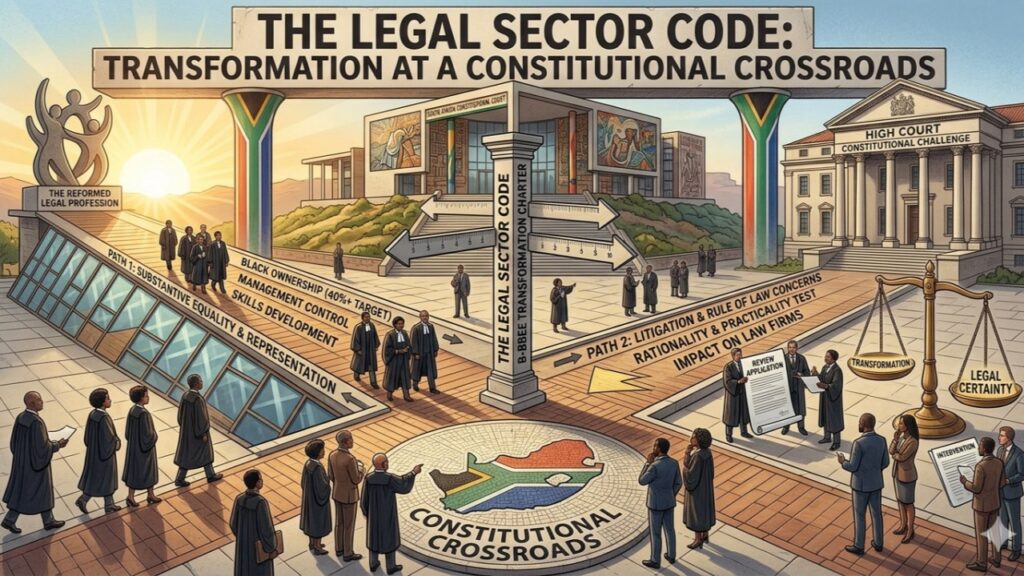
The Legal Sector Code, promulgated under section 9(1) of the Broad-Based Black Economic Empowerment Act 40 of 2013, as amended, represents a significant step towards transforming South Africa’s legal profession. Grounded in the constitutional values of equality and substantive transformation, the Code seeks to address the enduring effects of historical racial exclusion by promoting equitable ownership, participation, and advancement within the legal sector. While widely regarded as a necessary mechanism to accelerate transformation, the Code has also sparked considerable debate, particularly among large commercial law firms that contend that certain requirements, including the ownership targets, are impractical and difficult to achieve.
The legacy of apartheid continues to shape structural inequality in South Africa’s socio-economic order. Apartheid legislation systematically excluded black South Africans from participation in skilled and professional sectors, reserving economic opportunity and ownership for a minority and entrenching long-term disparities in education and professional development.
Within the legal profession, these historical patterns are reflected in measurable structural imbalances. Black practitioners remain underrepresented in ownership and senior decision-making positions in large commercial firms and continue to experience disparities in access to quality work, briefing patterns, and exposure to complex and high-value instructions. Statistics South Africa records that in 2022, white South Africans constituted approximately 7.7% of the population compared to 92% black South Africans. Legal Practice Council data (April 2023) shows that in large racially mixed firms, 72% of partners or directors are white and approximately 25% are black, while representation is more balanced at the associate level (59% black).
The Legal Sector Code (LSC) is premised on the recognition that economic transformation is a constitutional imperative and that substantive equality, as envisaged in the Bill of Rights, cannot be achieved without meaningful structural change. It identifies Broad-Based Black Economic Empowerment (B-BBEE) as the primary instrument for advancing transformation within the legal profession. The Code sets clear objectives aimed at restructuring the profession, including aligning its demographic profile with that of the Republic, accelerating change in ownership, control, and management, strengthening the representation of black women in leadership, and expanding access for black practitioners to specialised and high-value areas of legal work.
To implement these objectives, the Code introduces sector-specific B-BBEE scorecards covering ownership, management control, skills development, and procurement. The Code requires qualifying law firms to increase black voting rights and ownership from 25% to 50% within a strict 5-year period. It further establishes a Legal Sector Transformation Fund to support transformation initiatives, including funding for black-owned firms, pupillage support, and targeted assistance for black women practitioners, including during maternity leave. A Charter Council is also envisaged to monitor compliance, oversee implementation, and report annually on transformation outcomes.
The implementation of the Legal Sector Code has given rise to a constitutional challenge before the High Court of South Africa (Pretoria) in the matter between Norton Rose & Others v Minister of Trade, Industry and Competition, Case No: 2024-149523. The application has been instituted by big law firms, which seek an order declaring the Code unconstitutional and unlawful.
At the heart of the challenge is the contention that the Code represents a decisive departure from the previous generic B-BBEE framework by introducing binding and accelerated transformation targets. The applicants argue that these requirements are structurally incompatible with the realities of legal practice. They point out that ownership in law firms is restricted to practising attorneys who carry personal liability, and that progression to equity partnership typically occurs over a prolonged career trajectory. Against this backdrop, they contend that the timelines imposed by the Code are commercially and operationally unworkable and threaten the sustainability of established firms. They further submit that non-compliance will significantly affect B-BBEE ratings, with direct consequences for access to both public and private sector work.
The applicants further argue that the Code disregards previously recognised transformation mechanisms under earlier B-BBEE frameworks, including bursaries, development contributions, and pro bono work, which firms argue have historically formed part of the profession’s transformation pipeline. Concerns are also raised regarding scope, as the Code excludes smaller firms with one to three partners, thereby limiting its reach across the profession. They further contend that the Code lacks adequate empirical justification, particularly in relation to the accelerated ownership targets, which they argue depart materially from earlier technical recommendations and were not properly substantiated in the final formulation.
The respondents, constituting several legal professional and representative bodies, including the Legal Practice Council and the National Association of Democratic Lawyers, support the Code as a constitutionally justified and necessary measure. They argue that it gives effect to the constitutional mandate of transformation by addressing long-standing structural inequalities and correcting persistent imbalances in ownership, control, and senior representation within the legal profession.
The Minister of Trade, Industry and Competition, Parks Tau, submits that the Code was properly adopted in accordance with applicable legal procedures and aligns with the Broad-Based Black Economic Empowerment Act. He argues that it is intended to remedy the continuing effects of historical exclusion and to promote substantive economic participation within the legal profession.
The competing positions before the court underscore that the Legal Sector Code is more than a technical regulatory instrument; it sits at the centre of a broader contest about the pace, form, and substance of transformation within the legal profession. On one view, it represents a necessary corrective to entrenched structural inequality, while on the other, it is viewed as an intervention that may impose demands beyond the operational realities of legal practice. This tension highlights that the dispute is not merely about compliance thresholds, but about the future architecture of the profession itself and the means by which constitutional transformation is to be achieved.
The Legal Sector Code represents a pivotal moment in the ongoing effort to give substantive effect to constitutional equality within the legal profession through meaningful structural transformation. The matter currently before the High Court will be the next critical step in determining how this framework is interpreted and applied in law. Beyond the litigation, however, the more enduring question lies in the practical impact of the Code, whether it will deliver tangible transformation and deepen black economic empowerment in a meaningful way. Ultimately, this moment calls for more than incremental change; it marks a point of reckoning in which the profession is confronted with the question of whether transformation will remain aspirational, or whether it will translate into decisive, structural, lasting reform.
Candidate Attorney