
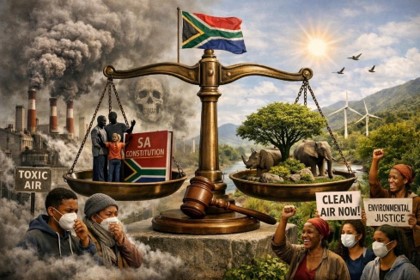
In June of 2025, the Greenpeace Africa and Centre for Research on Energy and Clean Air (CREA) released a new report indicating that about 42,000 South Africans lost their lives due to exposure to fine particle pollution in 2023 alone. This is a devastating reality of our country, but is there hope for a more sustainable future?
Particle pollution, or PM2.5, is a pollutant formed primarily by burning coal and fuel. It is minute enough to enter the human body through inhalation, travel into the lungs, and ultimately reach the bloodstream. Continuous exposure, or exposure in high concentrations, results in respiratory illness and, tragically, death. Yet the danger extends beyond health. Dust and black carbon also increase atmospheric heat absorption, raising surface temperatures by up to 2–3°C. These climatic shifts contribute to diminished water availability, excessively heated summer conditions, and increasingly erratic weather patterns we presently experience.
Section 24 of the Constitution of the Republic of South Africa, 1996 (“the Constitution”), guarantees everyone the right to an environment not harmful to health or well-being, and to have the environment protected for present and future generations through reasonable legislative and other measures. Our Constitution, thus, lays a solid foundation for environmental constitutionalism. Environmental constitutionalism is understood as a legal framework that entrenches environmental rights, obligations, and principles within the constitutional order. Yet the notion alone cannot withstand the multidimensional environmental crisis South Africa presently confronts. This article will argue, through the lens of air pollution, that equilibrating other constitutional guarantees with transformative environmental constitutionalism may offer the most viable path to ensuring that environmental rights are not only recognised but effectively realised.
The National Environmental Management: Air Quality Act 39 of 2004 (“NEMAQA”) is one of the legislations enacted to give effect to Section 24 of the Constitution. It establishes national ambient air quality standards, mandates licensing activities that emit pollutants and provides for the monitoring of these implementations. Yet enforcement remains weak. The legislative framework is overly rigid and formalistic, and as a result fails to adequately address the intersectional nature of, in this case, air pollution with other substantive rights, including health, food, water, and dignity.
While groundbreaking judgements such as Minister of Environmental Affairs v Trustees for the time being of Groundwork Trust and Others [2025] ZASCA 43 have advanced environmental constitutionalism by adopting a human-rights-based approach to policy formulation and monitoring; I submit that the stance taken by the Honourable Judge can be carried further. The human-rights-based approach ought to be weighed on the scale of justice with human rights on the one side and the environment, properly recognised as a distinct constitutional subject, on the other.
This shift would transform environmental constitutionalism from an abstract principle into a tangible, workable, and measurable concept. It would enable the development of solutions that preserve the integrity of all rights enshrined in Chapter 2 of the Constitution while ensuring that Section 24 remains a living guarantee —protecting the environment for the benefit of present and future generations. By balancing human rights on one side and the imperative to safeguard the environment that sustains us on the other, we simultaneously prioritise ourselves: safeguarding ecological integrity preserves our health, livelihoods, and dignity.
While there are many ways in which the practical application of this perspective could manifest, this article will propose three. First, enforcement under NEMAQA should be strengthened by imposing stricter penalties for non-compliance. Section 22A currently
prescribes a fine of R10 million for unlawful atmospheric emissions without the required licence. Yet this amount is insufficient, as large corporations can readily absorb the cost and continue their harmful activities covertly. The penalty should be substantially increased to serve as a genuine deterrent, thereby centring environmental protection and safeguarding continuity, rather than allowing revenue pursuits to eclipse the fragility of our environment.
Second, independent audits of air quality management plans should be mandated across the nation, conducted by environmental rights organisations rather than relying solely on annual reports submitted by organs of state under section 17 or the appointment of air quality officers under section 14 of NEMAQA. Independent oversight would tighten scrutiny, strengthen accountability, and move monitoring beyond excessive formalism towards compliance mechanisms that are wholistic, future-oriented and environment-centred, ensuring perpetual benefit for all South Africans.
Finally, transformative adjudication can assist by requiring government not only to adopt policies but to regularly demonstrate their effectiveness. This can be facilitated through community-centric accountability, such as conducting public participation in vulnerable areas to assess whether environmental interventions yield improved health outcomes and to capture community perspectives on sustainable practices. Such engagement ensures that environmental governance is both participatory and responsive, embedding constitutional guarantees in lived experiences.
By embedding these measures, environmental constitutionalism can evolve into a tangible framework for stronger governance. Preserving the environment is inseparable from preserving ourselves, and only by protecting the ecological systems that sustain life can we secure a healthier, more just, and sustainable future.
Candidate Attorney